Straightforward advice for protecting your privacy, spotting scams and arranging safer first meetings in Portsmouth.
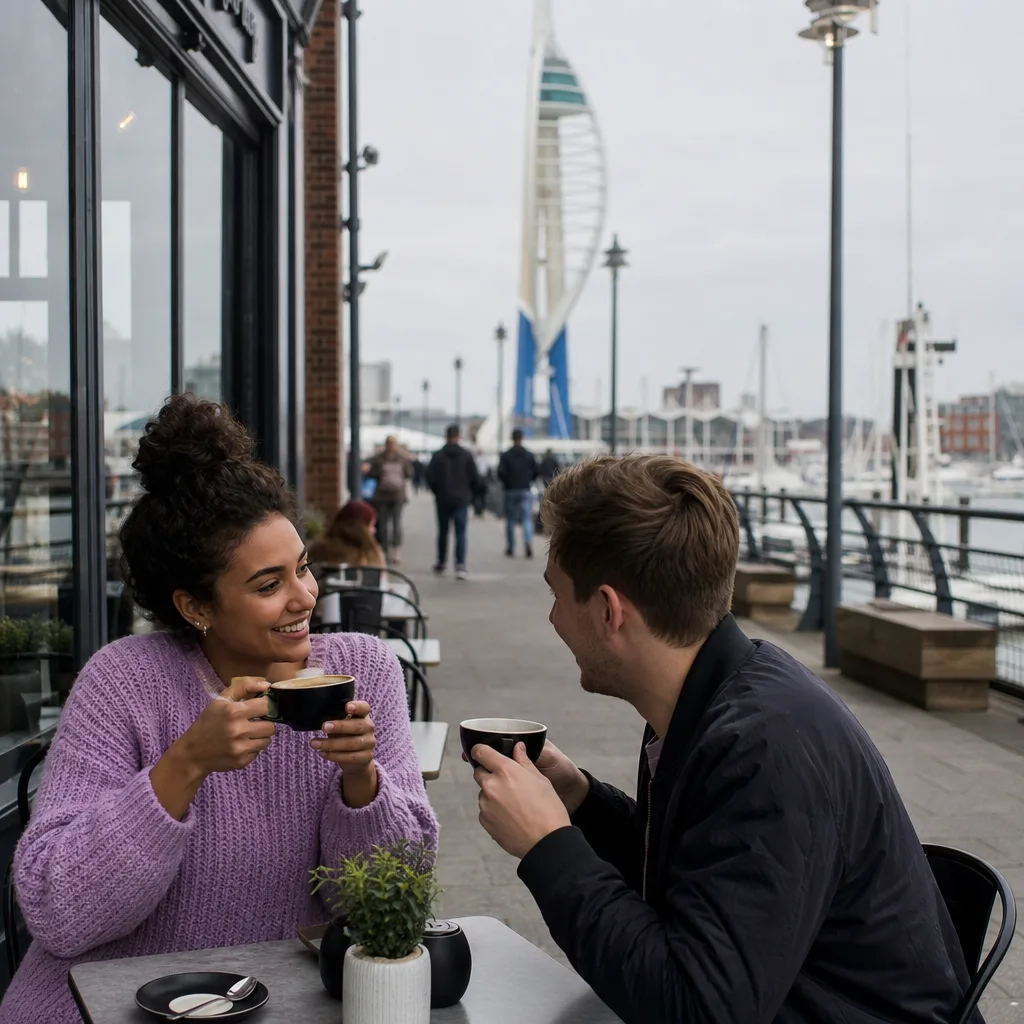
You have agreed to meet at Gunwharf Quays at seven. Their messages have felt normal, their photos look convincing and they know enough about Portsmouth to sound local. Then, an hour before you leave, they ask to move the date to their flat because it is “quieter”. Do you go?
No. Not for a first meeting. A last-minute change from a public place to a private address removes several of the safeguards you deliberately arranged. It does not prove the person is dangerous, but you do not need proof to keep the original boundary or cancel.
That is the central idea behind dating safety: you are not trying to conduct a criminal investigation into every person you meet. You are creating enough time, distance and choice to notice when something does not feel right.
What does safer dating actually involve?
Safer dating means protecting personal information, checking that a person is broadly who they claim to be and keeping control of when, where and how you meet.
Most Portsmouth singles are ordinary people hoping to find someone nearby. Safety advice should not turn them into suspects. Equally, friendliness is not evidence of honesty. A polished profile can belong to a decent person, a bored time-waster or a scammer using photographs copied from elsewhere.
Portsmouth's compact geography helps. Gunwharf, Commercial Road, Guildhall Square, Southsea and The Hard are not separated by an hour's drive, and buses, trains and licensed taxis provide alternatives to accepting a lift. The catch is that a compact city can also feel socially small. Colleagues, naval connections, neighbours and former partners may overlap. Privacy matters even when nobody has harmful intentions.
- Keep your options open. Arrange dates so you can leave independently, change your mind and get home without relying on the other person.
- Reveal information gradually. A first name, general interests and broad area are enough at the beginning. Your exact address and daily routine are not.
- Check consistency, not perfection. Honest people sometimes forget details or dislike video calls. Look for patterns rather than treating one awkward answer as a conviction.
- Believe pressure when you see it. Someone who argues with a reasonable safety boundary is giving you useful information about how they handle the word no.
- Use the site controls. Blocking and reporting are not overreactions. They are ordinary tools for ending unwanted contact and helping moderators review suspicious behaviour.
If you are still choosing where to meet people, compare the privacy settings, reporting process and payment terms described on dating sites in your area. Safety begins before the first message.
Protect Your Identity Before You Meet
A dating profile has a simple job: give another person enough to start a conversation. It does not need to function as your CV, address book and live location feed. The less identifying information you publish, the fewer pieces a stranger can join together.
How can I keep my dating profile private?
Use photos and details that show your personality without exposing your home, workplace, routine, surname or contact information.
Begin with the photographs. A picture that has never appeared on a public social account is harder to connect to your full name. Check the background for house numbers, workplace passes, school uniforms, vehicle registrations, mail and recognisable views from your home. Modern services often remove location metadata when uploading images, but do not rely on every platform doing so.
Portsmouth needs a little extra care here. Saying that you work “near the dockyard” is broad. Naming a small team, exact unit, ship's company or regular watch pattern can make you identifiable. Naval personnel and their families should also avoid sharing deployment dates, movements or operational details with a new contact. That is personal safety and sensible service security.
- Use only your first name. A surname, distinctive job title and neighbourhood can be enough to locate a social profile.
- Describe your area broadly. “Southsea” or “north Portsmouth” is useful. Your road, block or nearest small landmark can wait.
- Separate dating and everyday contact. Keep conversations on the platform until trust develops. If you later move away from it, consider a separate email address and review what your messaging profile reveals.
- Review linked accounts. Remove public links to Instagram, work pages or fitness apps that publish routes. A regular running map can point straight to your front door.
- Check notification previews. Hide message content on your locked screen if colleagues, children, family or a former partner could see it.
- Choose a unique password. Use a password manager where possible, and turn on two-step verification if the service offers it.
Privacy is not dishonesty. You can be truthful about your age, situation and intentions without giving an unfamiliar person the information needed to find you offline.
How do I check whether a dating profile is genuine?
Verify identity in small stages by checking whether photos, conversation, voice or video and real-world plans form a consistent picture.
No single check is conclusive. A video call shows that someone resembles their photographs, but it does not prove every claim in their biography. A sparse social profile may mean deception, or it may belong to someone who values privacy. In reality, you are looking for several ordinary facts that fit together.
- Read the whole profile. Notice contradictions in age, location, work, family situation or what they say they want.
- Ask natural local questions. Discuss everyday Portsmouth life rather than setting a pub quiz. Someone may genuinely live here without knowing your favourite café, but repeated vague answers deserve attention.
- Search a profile image. A reverse image search may reveal a photograph copied from a public figure, stock library or unrelated account. No result does not prove authenticity.
- Suggest a short call. Voice or video can clarify whether the person communicates as expected. Let them choose a reasonable time and do not pressure anyone to show their home.
- Keep the first meeting public. Online checks reduce uncertainty; they never replace sensible arrangements in person.
Practical tip: before sharing a profile photo, search that image yourself. If it leads directly to a public account containing your surname, employer and family details, use a different photograph or tighten the account's privacy settings.
Be careful with the idea of an identity “test”. Demanding a passport image, service ID, bank document or photograph holding handwritten text can expose both people to identity theft. A genuine person is entitled to protect their documents too.